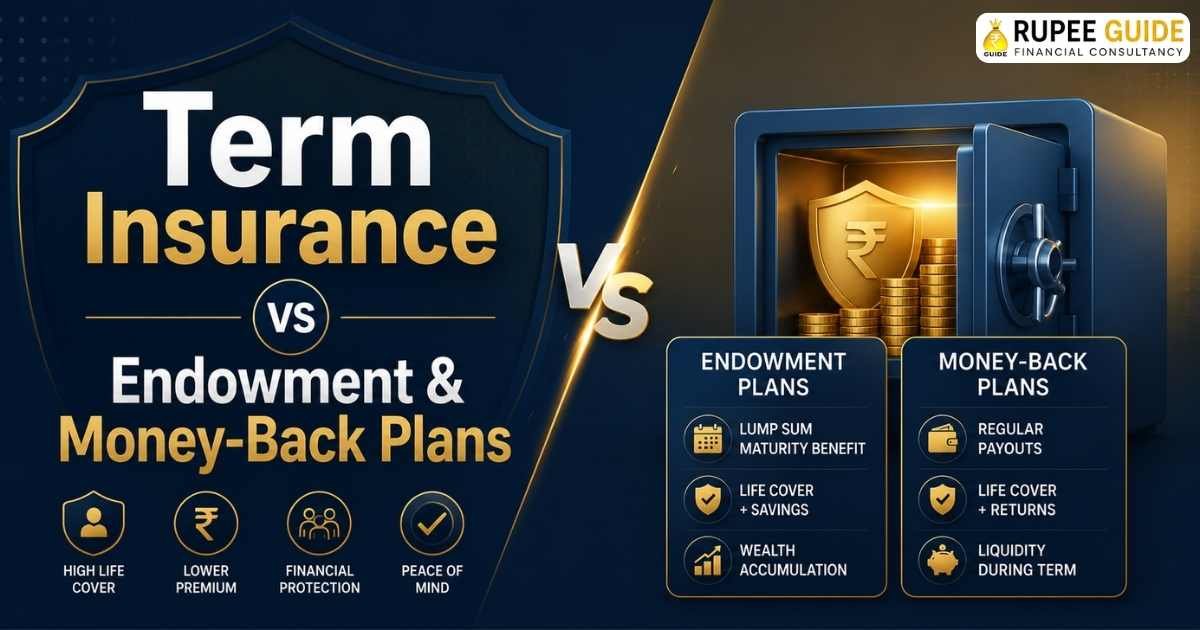
For decades, traditional life insurance agents across Bangalore and India have aggressively marketed Endowment, Money-Back, and Unit Linked Insurance Plans (ULIPs) as 'guaranteed double-benefit' products that provide life protection plus a maturity lump sum. However, when audited through objective financial engineering, traditional endowment plans are revealed to be among the most inefficient financial instruments in the Indian financial market, offering neither adequate life protection nor inflation-beating returns.
Executive Summary: Key Takeaways for Indian Investors
- Inadequate Life Cover: A ₹50,000 annual premium inside a traditional endowment plan provides a life cover of barely ₹10 Lakhs to ₹15 Lakhs—which will last an urban family less than 2 years in the event of breadwinner mortality.
- Low Internal Rate of Return (IRR): The net maturity IRR of standard 20-year endowment policies ranges between 4.2% and 5.3% per annum, falling well below real consumer inflation.
- The Winning Blueprint: Buy a ₹1.5 Crore to ₹2 Crore Pure Term Life Insurance policy for just ₹15,000 to ₹22,000 / year, and invest the remaining ₹30,000+ difference into high-performing equity mutual funds.
- The Wealth Difference: Over 20 years, the 'Term + Mutual Fund SIP' combination creates an extra ₹80 Lakhs to ₹1.2 Crores of net cash wealth compared to an endowment plan while delivering 10 times higher life protection from Day 1.
1. The Core Purpose of Life Insurance: Income Replacement
The sole economic purpose of life insurance is pure income replacement. If the primary earning member of a family passes away prematurely due to an accident or critical illness, the life insurance claim payout must be large enough to: (a) immediately clear all outstanding debts like home loans and personal loans, (b) generate a monthly interest income to cover household living expenses for the next 25+ years, and (c) fund major future milestones like child higher education and marriage.
To achieve this for a family living in Bangalore with monthly household expenses of ₹75,000, the required life insurance cover is at least ₹1.5 Crores to ₹2.0 Crores. Traditional endowment plans make it mathematically impossible for average earners to afford this level of coverage.
2. How Endowment & Money-Back Plans Work (And Why Premium is High)
In an endowment plan, the insurance company splits your annual premium into three parts: mortality costs (for life cover), administrative/agent commission charges (often 25-35% of the first-year premium), and a savings component invested primarily in low-yield government bonds.
Because the insurance company guarantees the return of your sum insured plus annual reversionary bonuses, they must invest conservatively. As a result, you pay a massive premium of ₹50,000 or ₹1,00,000 per year just to get a tiny life cover of ₹10 Lakhs or ₹20 Lakhs.
3. Mathematical IRR Breakdown: The 5% Reality Check
Let us examine a standard 20-year traditional endowment policy where the policyholder pays ₹50,000 every year for 20 years (Total deposit: ₹10,00,000). Upon completion of the 20-year policy term, the policyholder receives a maturity check of approximately ₹17,50,000 (Sum Insured + Bonuses).
Many investors mistakenly celebrate: "I got ₹7.5 Lakhs profit!" However, when you calculate the Internal Rate of Return (IRR) using exact compounding math across 20 years, the annual return on investment is exactly 4.85% per annum. With long-term education and lifestyle inflation above 8%, your net purchasing power has been eroded.
4. Pure Term Insurance: Maximum Cover at Minimum Cost
Pure Term Life Insurance is the purest, most transparent form of protection. You pay a small annual premium for a specific policy tenure (e.g., up to age 65 or 70). If the insured individual passes away during the policy term, the insurance company pays the full ₹1.5 Crore or ₹2 Crore sum insured immediately to the nominee as a tax-free lump sum under Section 10(10D). If the insured survives the term, there is zero maturity return—because your money bought 100% pure risk protection.
For a healthy 32-year-old male non-smoker residing in Bangalore, a ₹1.5 Crore Pure Term Insurance Cover up to age 65 costs approximately ₹16,000 to ₹19,000 per year—or roughly ₹45 per day.
5. The 'Buy Term & Invest the Rest' Strategy
Expert financial planners globally champion one golden rule: Never mix insurance with investment. Instead, separate the two needs completely using the Buy Term and Invest the Difference methodology.
| Strategy Dimension | Option A: Traditional Endowment Plan | Option B: Pure Term Cover + Equity Mutual Fund SIP |
|---|---|---|
| Annual Outflow (Budget) | ₹50,000 / year for 20 Years | ₹50,000 / year total budget for 20 Years |
| Life Insurance Coverage Amount | ₹10,00,000 (₹10 Lakhs only) | ₹1,50,00,000 (₹1.5 Crores — 15X higher!) |
| Annual Protection Cost | Entire ₹50,000 locked into policy | ₹16,000 toward ₹1.5 Crore Term Cover |
| Balance Invested in Equity SIP | ₹0 (Zero direct equity participation) | ₹34,000 / yr (₹2,833 / month into diversified ELSS/Flexicap) |
| Expected Maturity Corpus (Year 20) | ≈ ₹17,50,000 (@ 4.8% IRR) | ≈ ₹32,45,000 (@ 12.5% assumed CAGR on SIP) |
| Family Protection & Wealth Score | Severe under-insurance + low growth | 1500% higher family shield + ₹15 Lakhs extra wealth |
6. Case Study: The ₹1 Crore Cost of Wrong Advice in Whitefield
Case Study: Correcting an IT Director's Protection Gap
Background: Mr. Karthik S. (39), a Vice President at a tech firm in Whitefield earning ₹3.5 Lakhs per month, had purchased three different traditional money-back policies totaling an annual premium of ₹2,20,000. Despite paying this massive amount each year, his combined death benefit across all three policies was only ₹38 Lakhs.
The Audit by Rupee Guide: When Sathish M conducted a expert audit, he highlighted that if Karthik passed away unexpectedly, his ₹38 Lakh insurance payout would not even cover 50% of his outstanding ₹85 Lakh villa home loan in Whitefield, leaving his wife with zero monthly income replacement.
The Expert Restructuring: Sathish advised Karthik to make paid-up or surrender the inefficient endowment policies based on surrender value math. Sathish secured a ₹3 Crore Pure Term Insurance policy for Karthik at an annual premium of ₹38,000. The remaining ₹1,82,000 of his annual budget was redirected into structured goal-linked Mutual Fund SIPs. Karthik's family protection jumped from ₹38 Lakhs to ₹3 Crores instantly, while his long-term wealth compounding accelerated by over ₹1.8 Crores across his retirement horizon.
7. Key Riders to Add: Critical Illness & Waiver of Premium
To fortify your pure term insurance policy, our advisors strictly recommend attaching two essential riders:
- Comprehensive Critical Illness Rider: If diagnosed with specified life-threatening conditions (such as cancer, heart attack, stroke, kidney failure, or major organ transplant), the insurer pays a lump-sum rider benefit (e.g., ₹25 Lakhs or ₹50 Lakhs) immediately upon diagnosis to cover loss of income and experimental therapies.
- Waiver of Premium on Disability Rider: If the policyholder suffers total permanent disability due to an accident and cannot work, all future annual premiums for the remaining policy term are completely waived by the insurer while keeping the full ₹1.5+ Crore life cover active until maturity.
8. Frequently Asked Questions
Detailed, expert answers to common questions regarding life insurance strategy:
Pure term insurance is an expense for absolute financial safety, exactly like car insurance or health insurance. You do not ask for a refund on your car insurance premium if you do not meet with an accident during the year. Similarly, paying ₹16,000 a year guarantees that if you die, your family receives ₹1.5 Crores. If you survive to age 65, you have lived a long, healthy life with your self-built mutual fund wealth intact—which is the ultimate victory.
No. In a Term with Return of Premium (TROP) plan, the insurance company charges nearly 80% to 100% higher annual premium compared to a pure term plan just to refund your premiums at age 65 without any interest. If you take a pure term plan and simply invest the extra premium difference into an index mutual fund SIP, your investment return will be 4 to 5 times larger than the refunded premium.
Under Section 45 of the Insurance Act, once a life insurance policy has been active and continuously enforced for exactly 3 years (36 months) from the date of issuance, the insurance company legally cannot reject a death claim on any grounds whatsoever, including alleged misstatement or fraud. Therefore, complete honest disclosure of existing health conditions and smoking habits during initial application under Sathish M's guidance ensures 100% guaranteed claim settlement.
9. Schedule Your Free Consultation
We help you understand your wealth and tax goals with simple and clear planning. At Rupee guide financial consultancy, we conduct comprehensive, conflict-free audits tailored to Bangalore and PAN India families.