Whenever a Bangalore professional or business owner receives a sudden, significant cash windfall—whether from a ₹50 Lakh annual performance bonus, the ₹1.5 Crore sale of an ancestral property or apartment, or the ₹80 Lakh maturity of corporate ESOPs—they face a paralyzing investment dilemma: If I invest this entire ₹50 Lakh lump sum into Equity Mutual Funds today and the stock market crashes by 15% next week, I will instantly lose ₹7.5 Lakhs of my hard-earned capital! But if I leave it sitting inside a Savings Account or Fixed Deposit out of fear, I am losing ₹5,000 every single day in missed compounding returns! This guide explains how Sathish M at Rupee guide financial consultancy solves this dilemma using the Systematic Transfer Plan (STP) to safely deploy multi-crore lump sums with zero market timing risk.
Executive Summary: Key Takeaways for Bangalore & PAN India Investors
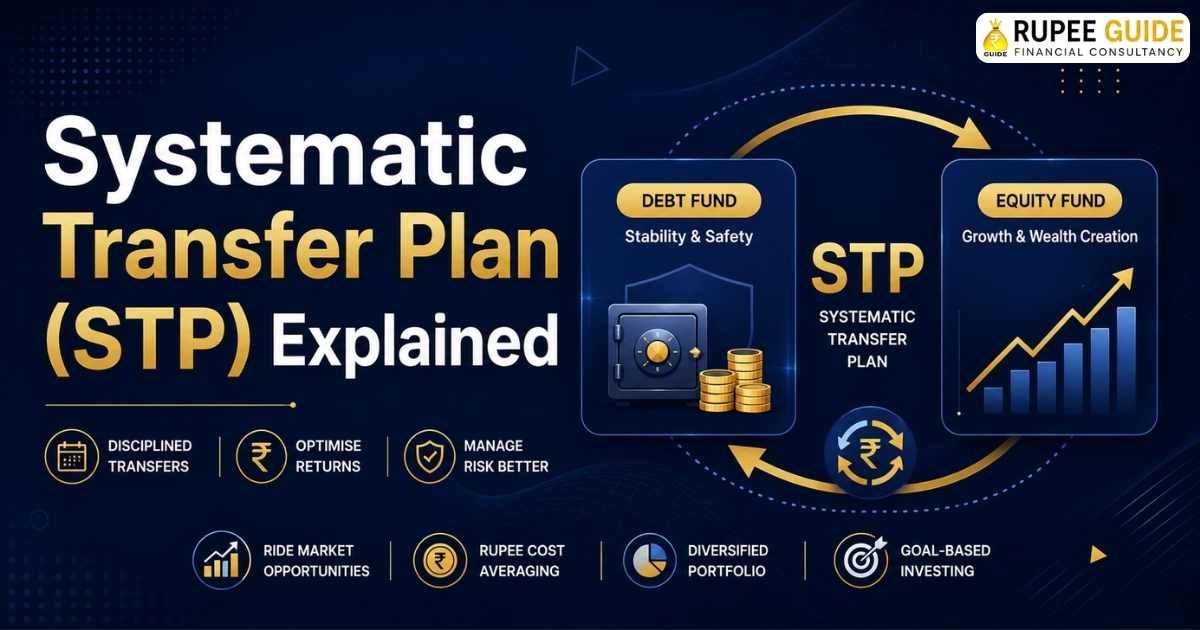
- What is a Systematic Transfer Plan (STP)? An STP is an automated institutional mechanism where your entire lump sum (e.g., ₹50 Lakhs) is deposited upfront into a rock-solid, capital-safe Liquid or Ultra Short Duration Debt Mutual Fund (earning ~6.8% to 7.2% annual interest). Every week or month, a fixed portion (e.g., ₹4 Lakhs) is automatically transferred (`Switched`) from the safe debt fund into your high-growth Flexi-Cap & Mid-Cap Equity Funds.
- The Double Compounding Advantage: While your lump sum waits in the liquid debt fund to be transferred over 12 months, the un-transferred balance continues earning ~7% debt interest daily! Meanwhile, every monthly transfer into equity captures Rupee Cost Averaging—buying more equity units when stock prices drop and fewer units when prices surge.
- Equity-to-Debt STP (The Goal De-Risking Shield): STP works in both directions! Exactly 3 years before your child's college deadline or your retirement date, we register an Reverse STP—transferring accumulated equity wealth systematically back into safe debt funds so a sudden bear market right before your milestone never hurts your capital!
- Automated Execution by Rupee Guide: We calculate the exact optimal STP tenure (6 months, 12 months, or 18 months) based on current stock market valuation ratios (`Nifty PE and PB metrics`) and register automated electronic switch mandates inside your folios.
1. The Psychology and Risk of Deploying Multi-Crore Lump Sums
In equity investing, the single greatest destroyer of wealth is not market volatility itself—it is Emotional Regret driven by bad entry timing. When an investor receives ₹50 Lakhs from a real estate sale or annual bonus, investing 100% of that cash on a single Tuesday afternoon when the Nifty index happens to be sitting at an all-time high is extreme speculative risk.
If global geopolitical tensions or interest rate surprises cause a sharp 12% market correction the following month, your ₹50 Lakh investment drops down to ₹44 Lakhs (`a ₹6 Lakh paper loss`). Over 80% of retail investors panic under this psychological pain and exit their funds at the exact market bottom—locking in permanent capital destruction. To ensure you sleep peacefully while entering the equity market, institutional deployment via STP is mandatory.

2. How STP Works: Combining Liquid Fund Yield with Rupee Cost Averaging
A Systematic Transfer Plan (STP) bridges the gap between total capital preservation and high equity growth by dividing your lump-sum entry into two distinct phases across a 6 to 18 month deployment corridor:
- Phase 1 (Immediate Parking): On Day 1, your entire ₹50 Lakh check is deposited directly into a high-credit-quality Liquid Mutual Fund or Overnight Fund within your selected AMFI fund house (e.g., HDFC Liquid Fund or a leading fund house Liquid Fund). This fund holds ultra-safe treasury bills and 91-day commercial paper, generating a steady, daily-accruing interest return of roughly 6.8% to 7.2% per annum.
- Phase 2 (Automated Monthly Tranches): On the 10th or 15th of every month over the next 12 months, exactly ₹4,16,666 is automatically switched out of the Liquid Fund and deployed into your target core Flexi-Cap and Mid-Cap Equity Funds. If the Nifty drops sharply during month 4 or month 7, your ₹4.16 Lakh monthly transfer automatically buys extra equity units at deep bargain discounts (`Rupee Cost Averaging`)—turning market volatility directly to your advantage!
3. Mathematical Table: Direct Lump Sum Deployment vs 12-Month STP
Let us examine the exact mathematical outcome of deploying a ₹60 Lakh lump sum during a volatile stock market year across two different entry strategies:
| Deployment Strategy Parameter | Option A: Direct 100% Lump Sum Entry on Day 1 | Option B: Rupee Guide 12-Month STP (₹5 Lakh / Month) |
|---|---|---|
| Upfront Capital Safety on Day 1 | Zero safety; 100% exposed to immediate stock market swings | 100% parked inside safe Liquid Fund earning ~7.0% interest |
| Behavior During a Sudden 15% Market Dip in Month 5 | Portfolio suffers heavy ₹9 Lakh paper loss; high emotional panic | Monthly ₹5 Lakh tranche automatically buys 15% more units at bargain prices! |
| Interest Earned on Un-Transferred Capital Pool | Zero (Since 100% was already dumped into equity on Day 1) | ≈ ₹2,25,000 (₹2.25 Lakhs of pure extra debt interest earned while transferring!) |
| Emotional & Psychological Peace of Mind | High anxiety monitoring daily market movements | 100% stress-free; fully automated discipline across the year |
| Final Portfolio Resilience at Year 3 | Vulnerable to entry-day market valuation overpricing | Superior unit accumulation cost base; smoother multi-year compounding! |
4. Fixed STP vs Capital Appreciation STP vs Capital Shield STP
Depending on your income bracket and risk appetite, Sathish M at Rupee guide financial consultancy executes three specialized variants of the Systematic Transfer Plan:
- Fixed STP (The Standard Gold Standard): A fixed, unvarying rupee installment (e.g., exactly ₹3 Lakhs) is transferred from the liquid fund to the equity fund every month across 12 or 18 months until the liquid pool reaches zero.
- Capital Appreciation STP (The Pure Profit Transfer): Designed for ultra-conservative senior citizens who hold ₹1 Crore in a short-term debt fund. Every month, only the interest accrued on the ₹1 Crore capital across that month (~₹58,000) is transferred into equity mutual funds! Your original ₹1 Crore principal balance inside the debt fund remains untouched and 100% protected forever while the interest builds an equity fortune!
- Flexi STP / Valuation-Triggered STP: An advanced institutional variant where the monthly transfer amount adjusts dynamically based on market valuation metrics. When the market is undervalued (`Low Nifty PE`), the system transfers a higher tranche (e.g., ₹6 Lakhs); when the market is overheated (`High Nifty PE`), the system transfers a minimal tranche (e.g., ₹2 Lakhs).
5. Using Reverse STP (Equity to Debt) for Retirement De-Risking
While most investors use STP to enter the stock market (`Debt-to-Equity STP`), the most critical expert application executed by Rupee Guide is Reverse STP (`Equity-to-Debt STP`) for Capital Preservation before Goal Maturity.
If you are 57 years old and your equity mutual fund portfolio has grown to ₹6 Crores, your retirement is scheduled for age 60 (exactly 36 months away). If you keep that entire ₹6 Crores in 100% equity right up to the week of your retirement and a global economic recession hits, your ₹6 Crores could temporarily plunge down to ₹4.2 Crores—destroying your retirement dreams!
To ring-fence your life savings, Sathish M registers an Automated Reverse STP at Age 57: every month for 36 continuous months, roughly ₹16 Lakhs is systematically switched OUT of your equity funds and locked safe inside ultra-stable Arbitrage and Liquid Debt Funds. By your 60th birthday, your entire ₹6 Crore retirement corpus sits safe in indestructible debt reserves—ready to initiate your monthly SWP paycheck!
6. Case Study: Deploying ₹1.2 Crores from a Property Sale in Sarjapur
Case Study: Zero-Stress Deployment of ₹1.2 Crores for a Business Owner
Background: Mr. Rajesh V. (48), a manufacturing business owner in Bangalore, sold a commercial property near Sarjapur Road in early 2025 and received ₹1,20,00,000 (₹1.2 Crores) in net post-tax bank cash. He wanted to invest this capital across equity mutual funds to fund his FIRE retirement goal at age 55, but was deeply terrified of a potential stock market correction.
The Expert STP Blueprint by Rupee Guide: Sathish M advised Rajesh against depositing ₹1.2 Crores directly into equity on Day 1. Instead, Sathish deposited the entire ₹1.2 Crores into an AMFI-evaluated Liquid Debt Fund on January 15th, and registered a 15-Month Fixed STP Mandate transferring exactly ₹8,00,000 per month into a structured 4-scheme Flexi-Cap and Mid-Cap equity portfolio.
The Expert Outcome: During month 6 of the deployment schedule, global interest rate hikes triggered a sharp 11% market correction across Indian equities. Because Rajesh's STP was active, his ₹8 Lakh monthly transfer automatically acquired equity units at deep bottom prices while his remaining ₹72 Lakhs sitting inside the liquid fund continued generating ₹42,000 in monthly interest! By month 15, Rajesh's entire ₹1.2 Crores was fully deployed at an exceptionally favorable average purchase cost, compounding at 14.6% CAGR with zero emotional panic!
7. Tax Implications of STP Transactions: STCG and Exit Load Check
When you execute a Systematic Transfer Plan from a Liquid Debt Fund into an Equity Fund, you must understand the statutory income tax mechanics:
Every monthly transfer (`Switch-Out`) from your Liquid Fund into your Equity Fund is legally treated by the Income Tax Department as a Redemption of units from the Liquid Fund and a fresh purchase in the Equity Fund. Because Liquid Fund units are being redeemed within 6 to 18 months of initial deposit, any profit realized on the Liquid Fund units during each monthly switch is treated as Short-Term Capital Gains on Debt and taxed at your marginal income tax slab rate (31.2%+).
However, because Liquid Funds generate modest, stable returns (~7% per year), the taxable capital gain component inside each monthly transfer is extremely tiny (typically just a few thousand rupees of interest), resulting in negligible tax impact while providing multi-crore equity protection! Furthermore, Sathish M specifically selects Liquid and Ultra-Short Funds that have ZERO Exit Loads after 7 continuous days, ensuring your monthly transfers incur zero bank or mutual fund penalty charges.
8. Frequently Asked Questions
Detailed, expert answers to common questions regarding mutual funds & sip:
Yes, absolutely! An STP is not a rigid bank term loan or a locked contract. If you encounter an unexpected personal business emergency during month 5 of your 12-month STP schedule, you can immediately instruct Sathish M at Rupee Guide to cancel or pause the ongoing STP mandate within 48 hours. You retain full 100% operational authority to withdraw any un-transferred balance remaining inside your Liquid Fund directly to your personal savings account on any business day!
If the stock market has already suffered an extreme, historic crash (such as the 35% Nifty crash during March 2020 or a major global liquidity event) where Nifty price-to-earnings (P/E) valuations have plunged below historical averages, Sathish M at Rupee Guide will advise a modified strategy: instead of a slow 12-month STP, we execute an Accelerated 3-Month Weekly STP or a Strategic 50% Lump Sum Entry to immediately lock in generational bottom prices before the market V-shape rebound occurs!
To execute a meaningful institutional Systematic Transfer Plan, we typically recommend a minimum starting lump-sum deposit of ₹2,00,000 (₹2 Lakhs) inside your source Liquid Fund, paired with monthly STP transfers of ₹15,000 to ₹25,000 per month across a 8 to 12 month corridor. For multi-crore property sales or corporate bonuses, our private wealth desk configures bespoke weekly or bi-monthly transfer schedules across institutional direct folios.

9. Schedule Your Free Consultation
Achieving absolute clarity on your wealth, health, and tax goals requires structured risk management and objective portfolio engineering. At Rupee guide financial consultancy, we conduct comprehensive, conflict-free audits tailored to Bangalore and PAN India families.