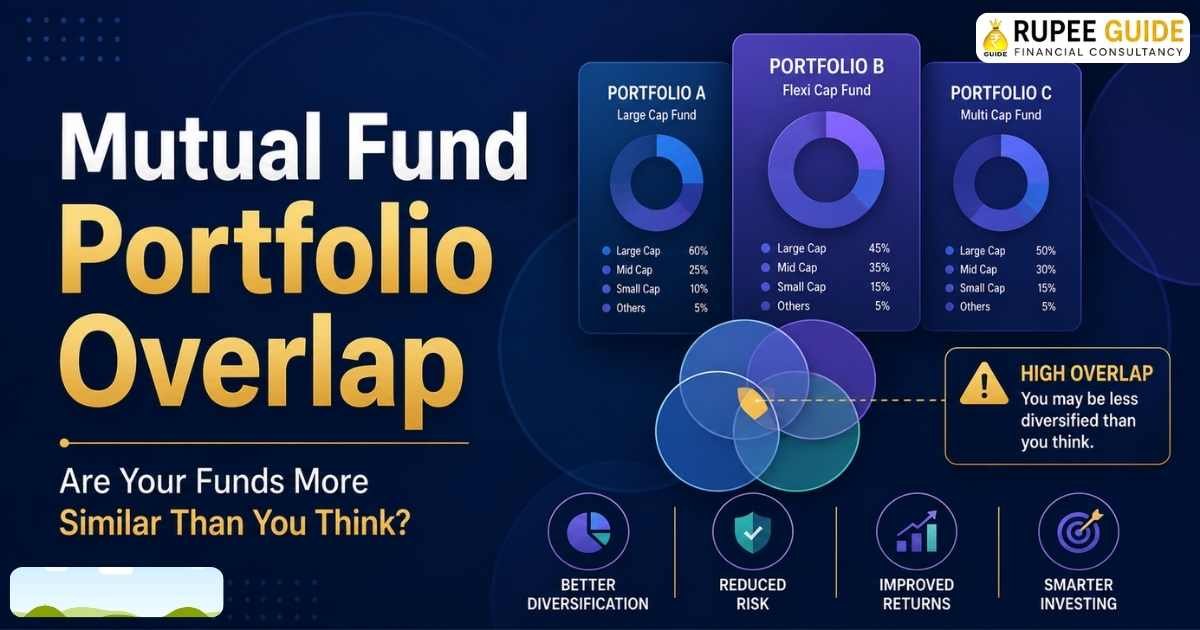
Whenever Sathish M conducts a new client portfolio audit at Rupee guide financial consultancy across Bangalore, he routinely encounters retail investors holding 12, 15, or even 20 different mutual fund schemes simultaneously. When asked why they hold so many funds, investors proudly state: 'Sathish, I am diversifying my risk across multiple AMCs like SBI, HDFC, ICICI, Axis, and Nippon!' However, deep fundamental analysis almost always reveals that 80% of these schemes are secretly investing in the exact same top 15 large-cap stocks—creating severe Portfolio Overlap that kills returns while multiplying administrative clutter.
Executive Summary: Key Takeaways for Indian Investors
- The Illusion of Diversification: Holding 5 different Large-Cap or Flexi-Cap mutual funds from 5 different AMCs does not mean you own 250 different stocks. Because of strict SEBI market capitalization benchmarks, all 5 funds heavily buy the exact same banking, IT, and energy giants (Reliance, a leading private bank stock, Infosys, TCS, a leading private bank stock).
- Over-Diversification Dilutes Alpha: When your mutual fund portfolio indirectly owns 180+ stocks across 12 overlapping schemes, your portfolio becomes a 'closet index fund.' You pay higher active fund management fees (1.8% expense ratio) only to get average market index returns!
- The Ideal Portfolio Size: Expert research proves that 4 to 6 carefully engineered, non-overlapping mutual fund schemes (e.g., 1 Flexi-Cap, 1 Large & Mid-Cap, 1 Small-Cap, and 1 Balanced Advantage Fund) capture 100% of optimal equity diversification.
- Free Overlap Audit: Our advisors use institutional diagnostic software to calculate your exact stock-by-stock overlap percentage and streamline your folios into high-alpha performers.
1. What is Mutual Fund Portfolio Overlap?
Mutual Fund Portfolio Overlap occurs when two or more different mutual fund schemes in your personal portfolio invest significant portions of their assets into the exact same underlying corporate stocks. For example, if Fund A has a 9% weightage in a leading private bank stock and 8% in Reliance Industries, and Fund B also has an 8.5% weightage in a leading private bank stock and 7.5% in Reliance Industries, holding both funds creates high concentration overlap.
If a leading private bank stock or IT sector stocks experience a temporary sector-wide correction, both Fund A and Fund B will crash simultaneously—destroying the very downside protection you attempted to achieve by purchasing two separate funds!

2. How SEBI Categorization Rules Create Overlap
In October 2017, the Securities and Exchange Board of India (SEBI) introduced strict mutual fund categorization rules. Under SEBI mandates, every Large-Cap mutual fund must invest a minimum of 80% of its total assets strictly into the Top 100 companies by market capitalization in India.
Because there are only exactly 100 large-cap companies available in the entire country, every single large-cap fund manager across all 44 AMCs in India is forced to pick stocks from the exact same narrow pool of 100 companies. Therefore, buying two or three different Large-Cap or Bluechip funds guarantees 65% to 85% direct portfolio overlap!
3. Real-World Table: Overlap Between 3 Popular Large-Cap Funds
Let us examine the factual underlying stock overlap between three of the most widely owned large-cap mutual fund schemes among retail investors in India:
| Top Underlying Stock Holding | SBI Bluechip Fund (% Weight) | a leading fund house Bluechip (% Weight) | HDFC Top 100 Fund (% Weight) |
|---|---|---|---|
| a leading private bank stock Ltd. | 9.45% | 9.82% | 10.15% |
| a leading private bank stock Ltd. | 8.12% | 8.65% | 9.05% |
| Reliance Industries Ltd. | 7.80% | 8.10% | 8.45% |
| Infosys Ltd. | 5.60% | 5.45% | 5.80% |
| Larsen & Toubro (L&T) | 4.25% | 4.50% | 4.65% |
| Combined Top 5 Concentration | 35.22% of Fund | 36.52% of Fund | 38.10% of Fund |
| Direct Stock Overlap Percentage | 72% to 78% EXACT STOCK OVERLAP ACROSS ALL THREE FUNDS! | ||
4. The 3 Hidden Dangers of Over-Diversified Folios
When you hold 10 to 15 mutual fund schemes with severe stock overlap, your portfolio suffers from three critical institutional disadvantages:
- Diworsification & Alpha Dilution: When a stellar mid-cap stock inside one of your schemes jumps by 100% in a year, because your capital is spread thin across 15 overlapping funds and 200+ stocks, that multi-bagger stock only represents 0.2% of your total net worth—resulting in zero visible impact on your wealth.
- Unnecessary Expense Ratio Burden: You pay active fund managers higher expense ratios (1.5% to 2.0%) specifically to make high-conviction stock picks that beat the market. When you hold 15 overlapping funds, your holdings mimic the Nifty 500 index exactly, meaning you are paying active fees for passive index-level performance!
- Administrative & Tax Nightmare during Rebalancing: When you need to rebalance your portfolio or withdraw funds for child college admission, tracking Exit Loads, Short-Term Capital Gains (STCG), and Long-Term Capital Gains (LTCG) across 15 different folios and 5 different AMC portals turns into an accounting nightmare for your family.
5. How to Conduct a DIY Portfolio Overlap Check
Before adding any new mutual fund scheme to your SIP list, conduct a simple 3-step overlap check:
- Step 1: Check Fund Categorization: Never hold two funds of the exact same SEBI category (e.g., never hold two Large-Cap funds, two ELSS funds, or two Small-Cap funds simultaneously). One top-quartile scheme per category is more than sufficient.
- Step 2: Inspect Top 10 Stock Holdings: Download the latest monthly factsheet from the AMC website and check if 6 or more of the top 10 holding companies in the new fund match the top 10 holdings of your existing fund. If yes, reject the new fund immediately.
- Step 3: Request an Institutional Audit: Contact Sathish M at Rupee Guide for an automated, institutional-grade stock overlap matrix report across your entire NSDL/CDSL CAS statement.
6. Case Study: Vikram's 16-Fund Clutter Cleanup in Electronic City
Case Study: Transforming 16 Cluttered Funds into 5 High-Alpha Engines
Background: Mr. Vikram R. (41), an Engineering Director in Electronic City, had been investing ₹85,000 via monthly SIPs for 7 years. Over the years, whenever a colleague recommended a '5-Star rated' fund or when a new NFO launched, Vikram added a ₹5,000 SIP. By 2026, his portfolio contained 16 different mutual fund schemes totaling ₹72 Lakhs.
The Diagnostic Audit by Rupee Guide: Sathish M ran Vikram's consolidated CAS statement through our institutional diagnostic software. The report revealed an astonishing 68% total portfolio overlap. Even though Vikram held 16 different funds across 11 AMCs, nearly ₹38 Lakhs of his ₹72 Lakh net worth was concentrated entirely inside the exact same 12 Nifty 50 banking and IT giants! His portfolio's 5-year annualized return was only 11.2%—lagging behind simple index funds.
The Expert Restructuring: Over a carefully planned 14-month tax-efficient glide path (to ensure LTCG remained below ₹1.25 Lakh tax-free limits per year), Sathish consolidated Vikram's 16 schemes into exactly 5 distinct, zero-overlap schemes (1 a top-performing flexi-cap fund, 1 Motilal Oswal Midcap, 1 Nippon Small Cap, 1 ICICI Balanced Advantage, and 1 SBI ELSS). Following the cleanup, Vikram's portfolio XIRR jumped to 16.4% across the subsequent 3 years, adding over ₹18 Lakhs of extra compounding value while making portfolio tracking effortless!
7. Engineering a Zero-Overlap 5-Fund Core Portfolio
To construct an unshakeable, all-weather equity mutual fund portfolio for a Bangalore professional with an aggressive risk profile and a 10+ year investment horizon, Rupee guide financial consultancy recommends the following 5-Fund Core Architecture:
- Core Fund 1: Flexi-Cap / Multi-Cap Fund (35% Allocation): Acts as the all-weather foundation, giving the expert fund manager dynamic freedom to shift capital between Large, Mid, and Small caps as valuations change.
- Core Fund 2: Mid-Cap Fund (25% Allocation): Captures high-growth Indian manufacturing, pharma, and mid-tier IT leaders ranked 101st to 250th by market cap.
- Core Fund 3: Small-Cap Fund (20% Allocation): Harnesses high-alpha compounding from emerging market challengers and specialized niche businesses.
- Core Fund 4: International / Global Equity Fund or Multi-Asset Fund (10% Allocation): Provides critical geographical currency diversification into US technology leaders (Apple, Microsoft, NVIDIA) or gold/silver commodities to hedge against Indian rupee depreciation.
- Core Fund 5: Balanced Advantage / Dynamic Asset Allocation Fund (10% Allocation): Automatically shifts between equity and debt using proprietary valuation models to buffer against sudden market volatility.
8. Frequently Asked Questions
Detailed, expert answers to common questions regarding portfolio audit strategy:
If you redeem or switch out of overlapping mutual fund schemes to consolidate into a core portfolio, the transaction is treated as a redemption under income tax laws. If held for more than 1 year, the profits are subject to Long-Term Capital Gains (LTCG) tax at 12.5% above the annual ₹1.25 Lakh tax-free limit. At Rupee Guide, Sathish M executes a structured Multi-Year Tax-Harvesting Plan, systematically redeeming only up to ₹1,25,000 in gains every financial year so that your entire portfolio consolidation is completed with zero capital gains tax!
If you buy two different Nifty 50 Index Funds from two different AMCs (e.g., HDFC Nifty 50 Index and UTI Nifty 50 Index), your portfolio overlap is literally 100% identical! Index funds are excellent low-cost cars for large-cap allocation, but you should only ever hold exactly ONE Nifty 50 or Nifty Next 50 index fund in your entire portfolio.
Yes, absolutely—provided they belong to completely different SEBI categories! For example, holding SBI Bluechip Fund (Large Cap) and SBI Small Cap Fund in the same portfolio is 100% fine because large-cap and small-cap schemes invest in completely different segments of the stock market with virtually zero overlap.

9. Schedule Your Free Consultation
We help you understand your wealth and tax goals with simple and clear planning. At Rupee guide financial consultancy, we conduct comprehensive, conflict-free audits tailored to Bangalore and PAN India families.