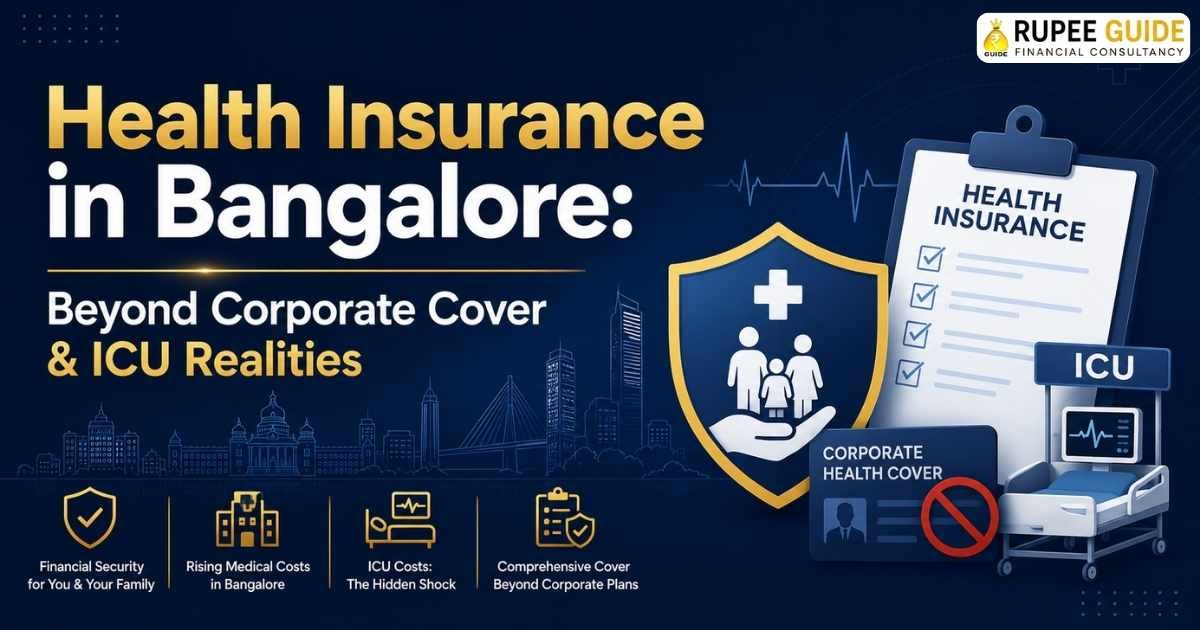
For thousands of IT professionals, corporate managers, and business owners residing across tech corridors like Sarjapur, Whitefield, HSR Layout, Indiranagar, and Electronic City, employer-provided group health insurance provides a soothing false sense of total financial security. Yet, when an unexpected midnight medical emergency forces a family member into a premier Bangalore tertiary care hospital, that ₹3 Lakh or ₹5 Lakh corporate policy rapidly crumbles against private ICU room charges and surgical billing sub-limits.
Executive Summary: Why Standalone Health Protection is Mandatory in Bangalore
- Medical Inflation in Bangalore: Private healthcare costs in Bangalore are expanding at 14% to 16% per annum—nearly triple the rate of general consumer retail inflation.
- The Room Rent Capping Trap: A standard 1% room rent cap on a ₹3 Lakh group cover restricts daily hospital room allowance to just ₹3,000. Admitting a patient into a ₹10,000 private room in hospitals like Manipal or Apollo triggers proportionate deductions across entire doctor, nursing, and OT bills.
- Job Transition Vulnerability: Your corporate insurance ceases instantly upon resignation, layoffs, or retirement, leaving you and your aging dependents completely uninsured during high-risk gaps.
- The Recommended Solution: Combining a ₹10 Lakh comprehensive base standalone policy with a ₹40 Lakh super top-up floater delivers ₹50 Lakhs of absolute private healthcare protection for a fraction of standard premium costs.
1. The Bangalore Healthcare Ecosystem: Why Medical Bills Have Skyrocketed
Bangalore stands proud as India's undisputed Silicon Valley and premier biotechnology hub. Parallel to this technological explosion, the city has developed one of the country's most advanced, highly specialized private medical ecosystems. From robotic heart surgeries and advanced neuro-critical care units to oncological proton therapy and complex multi-organ transplants, medical institutions in Bangalore deliver world-class clinical outcomes.
However, cutting-edge medical technology comes with a formidable price tag. In our everyday advisory practice at Rupee guide financial consultancy across South and East Bangalore, we routinely audit hospital discharge summaries where a 7-day ICU hospitalization for severe viral pneumonia or acute coronary intervention crosses ₹6 Lakhs to ₹9 Lakhs without surgical complication.
Let us examine the realistic billing breakdown of a standard tertiary care hospitalization in premier Bangalore healthcare facilities (such as Manipal Hospital Old Airport Road, Sakra World Hospital Sarjapur, Apollo Hospitals Bannerghatta Road, or Fortis Hospital Cunningham Road):
| Hospital Expense Category | Mid-Tier Nursing Home (Bangalore) | Premier Tertiary Care Hospital (Bangalore) | Impact on ₹3 Lakh Corporate Cover |
|---|---|---|---|
| Private Single Room Rent (Per Day) | ₹4,500 – ₹6,000 | ₹8,500 – ₹14,000 | Exceeds 1% capping (₹3,000/day limit) |
| ICU / CCU Charges (Per Day) | ₹9,000 – ₹12,000 | ₹18,000 – ₹32,000 | Exceeds 2% capping (₹6,000/day limit) |
| Surgeon & Specialist Consultation Fees | ₹45,000 – ₹65,000 | ₹1,20,000 – ₹2,50,000 | Subject to 50%+ Proportionate Deduction |
| Operation Theatre (OT) & Anesthesia Charges | ₹35,000 – ₹50,000 | ₹85,000 – ₹1,60,000 | Subject to Proportionate Deduction |
| Total 5-Day Surgical Hospitalization Bill | ₹2,10,000 – ₹2,80,000 | ₹5,50,000 – ₹8,20,000 | Insurer Pays ₹2.4L; You Pay ₹5.8L Out of Pocket! |
2. The Flaws of Corporate Group Health Insurance (GMC)
When you join an IT services giant, multinational corporation, or high-growth startup in Bangalore, HR executives highlight the Group Medical Coverage (GMC) as a primary employee benefit. While GMC policies are valuable because they cover pre-existing diseases (PED) and maternity from Day 1 without waiting periods, relying solely on them creates three catastrophic financial risks.
Risk A: Room Rent Capping and Proportionate Deductions
Most corporate insurance policies enforce a strict room rent limit of 1% of the sum insured for private wards, and 2% for ICU admissions. If your base corporate sum insured is ₹3 Lakhs, your daily room rent limit is capped at exactly ₹3,000 per day.
In Bangalore, finding a hygienic, single air-conditioned private ward in a premier hospital like Manipal, Aster CMI, or Sakra for ₹3,000 is practically impossible. When you get admitted to a ₹9,000 per day single room, you might assume you simply pay the ₹6,000 daily difference out of pocket. This is a dangerous misconception.
Insurance claim departments apply a penal clause known as Proportionate Deduction. Because you occupied a room costing 300% of your eligible limit (`₹9,000 vs ₹3,000`), the insurer reduces every single room-linked medical fee—including doctor visits, nursing charges, diagnostic scans, surgical fees, and OT rentals—by the exact same proportion (66.6% reduction). On an ₹8 Lakh final hospital bill, your corporate insurance reimburses merely ₹2.5 Lakhs, forcing you to liquidate fixed deposits or sell mutual fund units to pay the remaining ₹5.5 Lakhs.
Proportionate Deduction Formula & Financial Penalty
Proportionate Claim Paid = Total Eligible Bill × (Room Rent Limit / Actual Room Rent Chosen)
If Total Surgeon & OT Bill is ₹4,00,000 and you chose a ₹9,000 room against a ₹3,000 limit:
Insurer Reimburses: ₹4,00,000 × (₹3,000 / ₹9,000) = ₹1,33,333. You lose ₹2,66,667 directly due to room capping!
Risk B: The Job Transition and Layoff Vulnerability
In Bangalore's dynamic tech sector, professionals switch companies every 2 to 4 years. Furthermore, macroeconomic headwinds occasionally trigger corporate restructuring, downsizing, and voluntary retirement schemes (VRS). The moment you resign, hand over your company laptop, or face a layoff, your employer group health cover is extinguished instantly at midnight.
If you or a family member suffer a medical emergency during a 60-day employment transition gap, you have zero financial shield. Even if you immediately apply for a new retail health policy, you must serve fresh statutory waiting periods (30 days for general illnesses, 24 months for specific surgical procedures like hernia or cataract, and 36 to 48 months for pre-existing conditions like hypertension or diabetes).

3. How to Structure a ₹50 Lakh Family Health Shield in Bangalore
To insulate your household against private ICU billing realities without paying ₹80,000+ per year in insurance premiums, Sathish M (`AMFI Registered ARN: 118178`) recommends the Base Floater + Super Top-Up Architecture.
Recommended ₹50 Lakh Blueprint for an IT Couple (Age 34 & 32)
Instead of buying a single ₹50 Lakh comprehensive retail policy that costs upwards of ₹65,000 annually, split your risk management into two synchronized policies:
- Step 1: Buy a ₹10 Lakh Base Standalone Family Floater Policy with Zero Room Rent Capping and No Co-payment clauses from a reliable insurer (e.g., a top IRDAI-approved health insurer Assure / HDFC ERGO Optima Secure). Annual Premium: approximately ₹18,500.
- Step 2: Buy a ₹40 Lakh Super Top-Up Policy with a ₹10 Lakh Deductible. Because the super top-up policy only activates after total hospitalization bills in a financial year cross ₹10 Lakhs, the statistical risk for the insurer is exceedingly low. Annual Premium: approximately ₹6,200.
Total Combined Coverage: ₹50 Lakhs | Total Annual Premium: ~₹24,700 per year! You save nearly ₹40,000 every single year while securing an unbreakable ₹50 Lakh fortress against catastrophic ICU admissions.
4. Essential Policy Clauses to Audit Before Purchasing
Before signing a proposal form or transferring annual premiums, verify that your health insurance policy satisfies these strict expert criteria:
- No Room Rent Restrictions: Ensure the policy document explicitly states "Any Room Category" or "Single Private Air-Conditioned Room without capping."
- Annual Restoration / Reload Benefit: If your entire ₹10 Lakh base cover is exhausted due to a heart surgery in July, the insurer should automatically reload 100% (another ₹10 Lakhs) at zero additional cost for any subsequent medical emergency occurring later in the same policy year.
- Daycare Treatments & Modern Robotic Surgeries: Advanced medical procedures like chemotherapy, cataract surgery, coronary angiography, and robotic prostatectomies no longer require 24-hour hospitalization. Your policy must cover all 500+ daycare surgical procedures unconditionally.
- Pre & Post Hospitalization Expenses: Diagnostic blood panels, MRI scans, specialist consultations, and pharmacy bills incurred 60 days prior to hospital admission and 90 to 180 days after hospital discharge must be reimbursed fully.
5. Tax Optimization: Maximizing Section 80D Benefits
Structuring your health insurance correctly does not just safeguard your savings during hospitalization—it directly reduces your annual income tax liability under Section 80D of the Indian Income Tax Act.
For an individual residing in Bangalore paying taxes under the old tax regime, annual health premiums unlock two distinct deduction buckets:
- Bucket 1 (Self, Spouse & Dependent Children): You can claim a direct deduction up to ₹25,000 per financial year (`or up to ₹50,000 if you or your spouse are senior citizens aged 60+`).
- Bucket 2 (Parents' Health Coverage): If you pay health insurance premiums for your parents, you can claim an additional deduction up to ₹25,000 per year (`or up to ₹50,000 per year if your parents are senior citizens aged 60+`).
Maximum Section 80D Tax Savings Breakdown
If you (`Age 38`) pay ₹24,000 for your family floater, and ₹48,000 for your senior citizen parents' (`Age 66 & 62`) health cover:
Total Tax Deduction Claimed = ₹24,000 + ₹48,000 = ₹72,000.
In the 30% tax slab (`plus 4% health & education cess = 31.2% effective tax rate`), claiming ₹72,000 under Section 80D puts exactly ₹22,464 in pure cash savings back into your bank account every tax filing year!
6. Frequently Asked Questions
Corporate group health policies typically offer ₹3 Lakh to ₹5 Lakh coverage for the entire family with room rent capping of 1% (`₹3,000 to ₹5,000 per day`). In premier private hospitals across Bangalore like Manipal, Apollo, or Sakra World Hospital, private rooms cost upwards of ₹8,000 to ₹15,000 per day, triggering proportionate deductions that force families to pay 40% to 60% of their total hospital bills out of pocket.
Due to medical inflation running at 14-16% annually in Bangalore's private healthcare ecosystem, a family of four should maintain a total coverage of at least ₹25 Lakhs to ₹50 Lakhs. The most cost-effective method is combining a ₹10 Lakh Base Standalone Family Floater with a ₹40 Lakh Super Top-Up policy.
When your health insurance policy has a 1% room rent cap on a ₹5 Lakh policy (`capping room rent at ₹5,000 per day`) and you get admitted to a private room costing ₹10,000 per day in a Bangalore tertiary care hospital, insurers apply a 50% proportionate deduction not just on the room rent, but across all associated treatment expenses including surgeon fees, anesthesiologist fees, nursing charges, and operation theatre rent.
Yes. Under Section 80D of the Indian Income Tax Act, you can claim up to ₹25,000 per financial year for premiums paid toward your individual or family standalone health insurance policy, and an additional deduction up to ₹50,000 for premiums paid for your senior citizen parents aged above 60, totaling ₹75,000 in annual tax deductions.
Need a Personalized Health Insurance & Wealth Audit in Bangalore?
Avoid costly hospital claim rejections and sub-limit penalties. Consult directly with Sathish M (`AMFI Registered ARN: 118178`) to structure your household's ₹50 Lakh standalone protection and Section 80D tax strategy.